“The most valuable discoveries are often not entirely new ideas, but familiar ideas seen from a different perspective.”
The Observation
The greatest innovations of the last century did not make experts more powerful. They made ordinary people more capable. Roads expanded mobility. Telecommunications expanded communication. The Internet expanded access to information. None of these technologies succeeded because people changed their behavior to accommodate them. They succeeded because the technologies quietly adapted to the way people already lived, worked, and communicated.
The best infrastructure eventually becomes invisible. People no longer think about roads when they drive. They no longer think about the Internet when they send an email or watch a video. The infrastructure simply works.
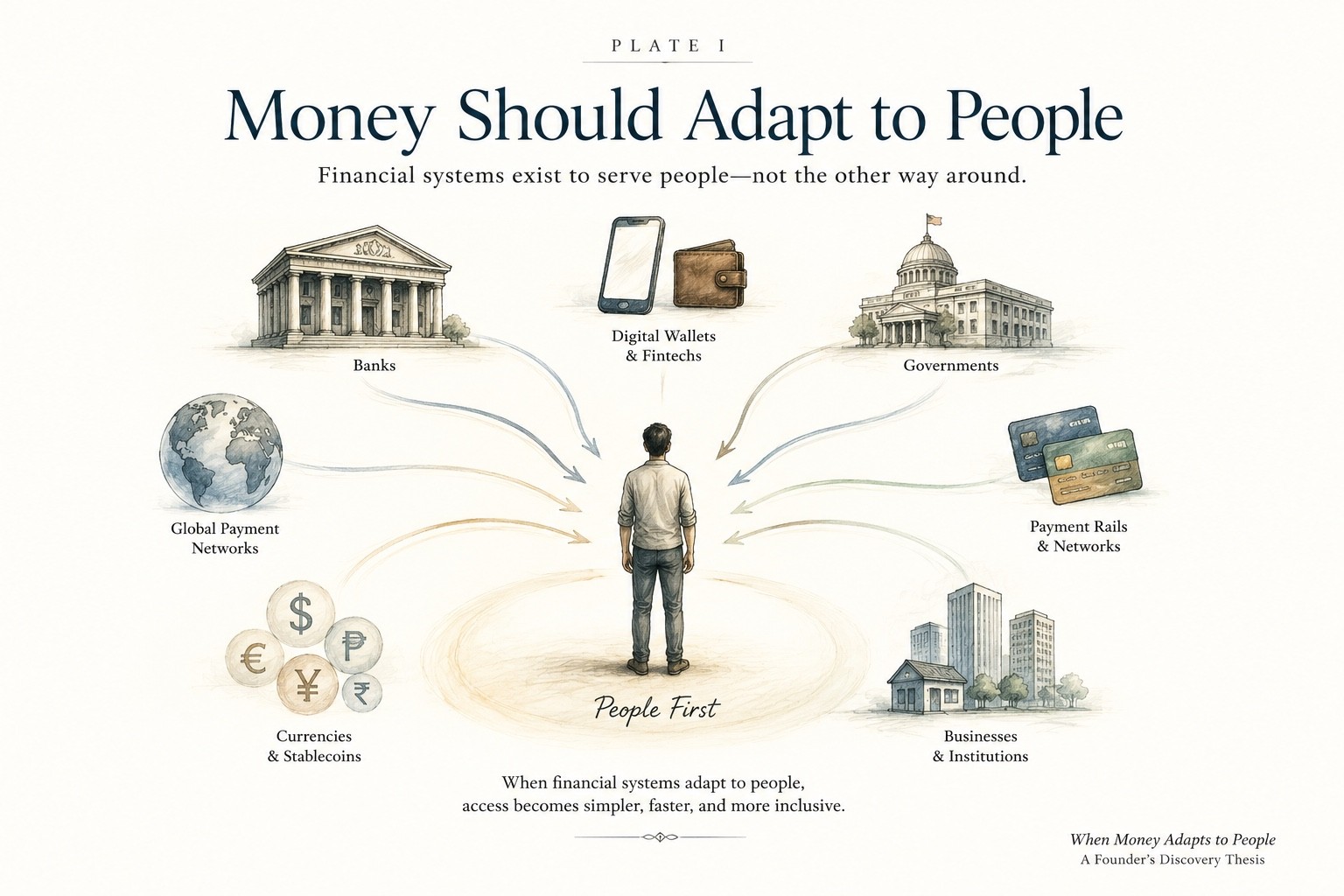
Money, however, seems to have followed a different path. Over the past several decades, we have built faster payment rails, more sophisticated banking systems, digital wallets, mobile banking applications, cryptocurrencies, and real-time settlement networks. Yet for billions of people, moving money still requires adapting to the system rather than the system adapting to them.
People open new bank accounts because someone else requires a particular bank. Workers download new wallets because their employer supports only one provider. Families receiving remittances must accept whatever payment channel the sender happens to use. Businesses maintain relationships with multiple banks simply to reach different customers. Governments distribute assistance through whatever infrastructure is available, rather than through the infrastructure people actually use.
The technology has become faster. The experience has not necessarily become simpler. Perhaps we have been solving the wrong problem.
Perhaps the next great financial innovation is not another payment rail, another bank, another wallet, or another currency. Perhaps the real opportunity lies in designing financial infrastructure that quietly adapts to people's lives instead of requiring people to adapt to financial infrastructure.
Because in the end, money should adapt to people. Not the other way around.
The Discovery
When people discuss the future of money, the conversation almost always begins with new technology. Artificial Intelligence. Blockchain. Cryptocurrencies. Central Bank Digital Currencies. Tokenization. These innovations are important, and each attempts to solve a different class of problems.
But what if the most significant breakthrough in financial settlement does not begin with inventing something entirely new? What if it begins by seeing something familiar in an entirely different way?
Consider one of the oldest financial instruments still recognized throughout the world: the paper check. For generations, a check has represented something remarkably simple. It is not money. It is not a bank account. It is not cash. It is an instruction. It represents an obligation created by one party and intended to be fulfilled by another.
Long before the Internet existed, the paper check already separated the creation of an obligation from its eventual settlement. That distinction is more profound than it first appears. The check itself was never the payment. It merely carried the authority to make one.
Yet the paper check also carried the limitations of the era in which it was invented. It depended upon physical paper. Physical signatures. Physical presentation. Specific banks. Specific branches. Business hours. Manual verification. Human coordination. In other words, the financial instrument survived. The operating environment did not.
The realization came unexpectedly. Perhaps the paper check was never the obsolete part. Perhaps only its operating system became obsolete. Viewed through that lens, a paper check begins to look surprisingly modern. It behaves much like a portable financial instruction that remains valid until it is fulfilled. A claim waiting for settlement. A portable obligation. A Portable Settlement Contract.
The insight was not the invention of a new financial instrument. The insight was recognizing that the instrument had existed all along. What never existed was a digital operating system capable of executing it across the increasingly diverse financial landscape of the modern world. That single realization changed the question entirely.
Instead of asking, “How do we build a better payment?” the better question became: “How do we build the operating system that allows financial obligations to move freely across any settlement destination?”
Everything that follows begins with that question.
Why Now?
Every generation discovers its most important technologies under different conditions. The steam engine emerged from the demands of industry. Commercial aviation grew from the need to shrink distance. The Internet transformed a world that was becoming increasingly connected. Financial settlement is approaching a similar moment. Not because money is changing. Because the world around money is changing faster than the systems designed to move it.
Ironically, the clearest signals are not always found in the world's most mature financial markets. They often appear where financial life is more dynamic, more fragmented, and more demanding. The developing world reveals problems that remain largely invisible in developed economies.
Consider the Philippines. Not because it is unique. But because it compresses many of tomorrow's global challenges into a single national economy.
More than ten million Filipinos live and work overseas. They earn in different currencies. They send money home through different remittance channels. Their families receive funds through banks, e-wallets, cash pickup locations, cooperatives, and an expanding ecosystem of digital financial services.
Within the country itself, millions of people move seamlessly between traditional banks and mobile wallets depending on convenience, availability, cost, and purpose. A salary may arrive in a bank account. Daily purchases may happen through an e-wallet. Bills may be paid through another channel. Government assistance may be distributed through yet another. The movement of money has become increasingly digital. The experience of managing it has become increasingly fragmented.
This fragmentation is not a temporary inconvenience. It is a preview of the future. As more payment rails emerge, more digital wallets appear, more national instant-payment networks interconnect, and more currencies coexist in an increasingly global economy, the number of settlement destinations will continue to grow—not shrink.
The question is no longer whether financial systems can move money quickly. Most already can. The more important question is whether people should be expected to continually adapt every time the financial landscape changes.
Perhaps the environments that appear most complex today are simply revealing tomorrow's global reality a little earlier than everyone else. If that is true, then solving these problems is not merely a national opportunity. It is a global one.
The developing world is not simply a market waiting for technology. It may become the laboratory where the next generation of financial infrastructure is first discovered.
The Tipping Point
Every transformative platform reaches a moment when its value is no longer determined by the technology itself, but by the number of people who choose to use it. Roads became more valuable as more destinations were connected. Telephones became more valuable as more people owned one. The Internet became indispensable because everyone eventually joined the same network. Financial settlement has yet to experience its equivalent moment.
Today, every payment rail competes to become the destination. Banks compete for deposits. Wallets compete for users. Remittance companies compete for transactions. Each attempts to attract people into its own ecosystem.
But what happens when the destination is no longer chosen by the sender? What happens when the sender simply creates an obligation—and the recipient decides how it should be fulfilled?
Imagine an Overseas Filipino Worker sending money home. Today, the sender often asks: “Which bank do you use?” “Do you have GCash?” “Can you receive through this remittance company?”
Tomorrow, the conversation could become much simpler: “I've sent it.” “Receive it however you prefer.”
That single change alters the dynamics of the entire financial ecosystem. Banks no longer compete to persuade the sender. They compete to become the recipient's preferred destination. Wallets no longer compete merely to acquire users. They compete to become the easiest place to redeem value. Innovation shifts away from controlling the transaction toward delivering the best customer experience. Choice moves from the infrastructure to the individual.
As more banks, wallets, payment rails, and settlement providers participate, the value of the network grows for everyone. Not because one payment rail wins. But because all of them become reachable.
At that point, the greatest source of value is no longer any individual bank, wallet, or payment network. The greatest source of value becomes the operating system that allows all of them to work together.
History has repeatedly rewarded the companies that built the operating systems connecting industries—not the companies that attempted to own every destination within them. If financial settlement follows the same pattern, then the largest opportunity may not lie in building another payment rail. It may lie in building the operating system that allows every payment rail to participate in a larger, more connected financial ecosystem.
That possibility is not merely a technological shift. It is an economic one.
The Operating System
If financial settlement is becoming an increasingly connected ecosystem, then a new question naturally emerges. What coordinates it? Historically, transformative industries have not been defined solely by the products they produced. They have been defined by the operating systems that allowed entire ecosystems to evolve around them.
Microsoft Windows did not manufacture computers. It provided the operating system that allowed thousands of hardware manufacturers and software developers to work together. Android did not manufacture every mobile phone. It enabled an ecosystem of manufacturers, application developers, mobile operators, and billions of users to participate in a common platform. Visa did not replace banks. It connected them through a common network that made electronic payments practical at global scale. Bloomberg did not create financial markets. It organized information so that markets could function more efficiently.
Each succeeded for the same fundamental reason. They became coordination layers. They reduced complexity without replacing the participants already creating value.
Financial settlement appears to be approaching a similar point. The future is unlikely to be defined by a single bank, a single payment rail, a single wallet, or a single currency. The future is more likely to consist of an increasingly diverse ecosystem of institutions, payment networks, digital wallets, national settlement systems, and emerging financial assets. If that future arrives, coordination becomes more valuable than ownership.
This is the role envisioned for x-change. Not as another payment network. Not as another bank. Not as another wallet. But as a Settlement Operating System.
At the center of that operating system is a simple idea. Instead of tightly coupling an obligation to a specific settlement destination, represent the obligation itself as a portable financial instruction—a Portable Settlement Contract.
Once an obligation becomes portable, settlement becomes adaptable. Banks remain banks. Wallets remain wallets. Payment rails continue moving value. The operating system simply allows all of them to participate in fulfilling the same financial obligation. No participant loses its role. Each becomes more valuable because it can participate in a larger ecosystem.
In this model, innovation no longer depends upon replacing existing financial infrastructure. It depends upon allowing existing infrastructure to work together more intelligently. That is the role of an operating system. Not to compete with the ecosystem. To make the ecosystem possible.
Why It Matters
Every great infrastructure project ultimately accomplishes the same thing. It allows more people to participate. Roads allow people to reach markets. Telecommunications allow people to exchange ideas. The Internet allows people to exchange information.
The true measure of infrastructure is not the sophistication of the technology. It is the number of people whose lives become more productive because of it. Financial infrastructure should be judged by the same standard. Its purpose is not merely to move money faster. Its purpose is to expand economic participation. To make it easier for people to work, trade, save, invest, build businesses, support families, and contribute to their communities.
This is why the developing world matters. Not because it lacks technology. But because it reveals, more clearly than anywhere else, what happens when financial infrastructure struggles to keep pace with people's lives.
A worker leaves home to earn a living overseas. A small business serves customers through multiple digital channels. A farmer receives payments through one institution and purchases supplies through another. A family depends upon several financial services simply to participate in everyday economic life. These are no longer exceptional circumstances. They are becoming the global norm.
As economies become increasingly connected, people will continue to cross borders, change employers, adopt new financial services, and participate in multiple digital ecosystems throughout their lives. The question is whether financial infrastructure will evolve with them. Or whether people will continue adapting themselves to fragmented systems designed for a simpler world.
Choice is more than convenience. It is resilience. Freedom is more than technology. It is the ability to participate without unnecessary barriers. Opportunity is more than access. It is the confidence that people can engage in economic life using the financial relationships that make the most sense for them—not merely the ones available to them.
If financial settlement becomes more adaptive, participation becomes more inclusive. Markets become more competitive. Innovation accelerates. Institutions compete by creating better services instead of locking people into particular ecosystems.
Perhaps that is the greatest opportunity before us. Not simply to improve how money moves. But to expand who can fully participate in the modern economy.
Because when money adapts to people, people spend less time navigating financial systems—and more time creating value within them.
The Invitation
Every generation has the opportunity to rethink one piece of infrastructure that previous generations accepted as fixed. Roads changed how people moved. Telecommunications changed how people communicated. The Internet changed how people accessed information. Perhaps the next transformation is not about creating another form of money. Perhaps it is about changing the relationship between people and money itself.
This paper began with a simple observation. For decades, we have built faster ways to move money. Yet people continue adapting their lives to the financial systems surrounding it. Along the way, a different possibility emerged.
What if the real opportunity is not another payment rail? What if it is the operating system that allows every payment rail, every bank, every wallet, and every future financial institution to work together while allowing people to remain free to choose?
If this discovery is correct, its implications extend well beyond a single company, a single country, or a single generation of financial technology. The next financial operating system may not emerge from the world's largest financial centers. It may emerge from the places where the need to rethink money is greatest.
History reminds us that transformative ideas often arise where existing systems reveal their greatest limitations. Innovation follows necessity. The developing world has long been viewed as a destination for technology created elsewhere. Perhaps it is time to consider another possibility. Perhaps the developing world can become the place where the next generation of financial infrastructure is first imagined.
If that future comes to pass, the greatest contribution will not be another application, another bank, another wallet, or another payment network. It will be a simpler idea: that financial systems should quietly adapt to the lives people already lead.
Because ultimately, money should adapt to people. Not the other way around.
“There is nothing more powerful than an idea whose time has come.” — Victor Hugo